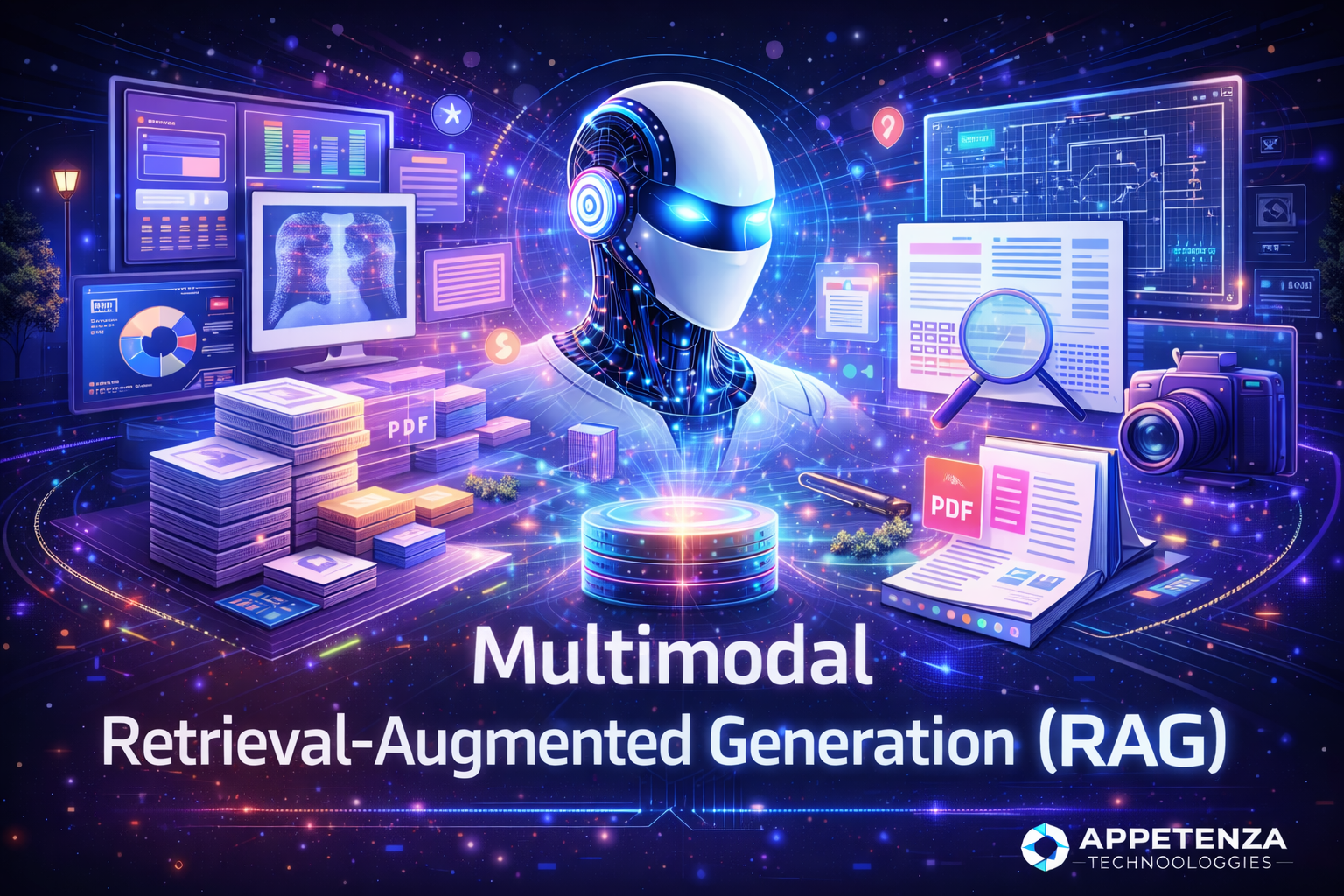
Multimodal RAG Systems: Extending Retrieval Beyond Text to Images, Tables, PDFs, and Visual Knowledge
-
 Appetenza
- 4 minutes, 3 seconds To Read
- 2026-01-31 23:41:55
Most Retrieval Augmented Generation (RAG) systems are built around text documents. However, real-world knowledge rarely exists in text alone. Technical manuals include architecture diagrams, research papers include charts and tables, dashboards include graphs, and troubleshooting guides often rely on screenshots. A text-only RAG system ignores a massive portion of human knowledge.
Multimodal RAG systems solve this problem by enabling retrieval across multiple data types — text, images, tables, structured data, and even scanned documents. This transforms a basic chatbot into a comprehensive knowledge assistant capable of understanding the full context of complex information sources.
Why Multimodal RAG Matters in Real Applications
Consider a DevOps assistant. A user asks: “What does the system architecture look like?” The answer may exist only in a diagram, not in text. Similarly, a medical AI assistant may need to interpret lab result charts. Financial AI systems may need to explain tables of quarterly performance.
If the system only retrieves text, it will miss critical insights stored in visuals or structured formats. Multimodal RAG ensures that all forms of knowledge are searchable and usable.
Understanding Multimodal Embeddings
Just as text is converted into vectors using embedding models, images and other media can also be transformed into numerical representations. Vision-language models learn to map images and text into a shared vector space. This allows similarity search between a user query and visual content.
For example, a diagram of a cloud network architecture can be embedded so that a query like “load balancer setup” retrieves the relevant diagram even if the diagram itself contains no direct textual match.
Handling Images in RAG
Images can contain structured information such as charts, screenshots, and design diagrams. There are several approaches to making images searchable:
- Image embeddings using vision models
- Optical Character Recognition (OCR) to extract embedded text
- Caption generation models to describe images in natural language
Often, systems combine all three methods to improve retrieval accuracy.
Retrieving Information from Tables
Tables are rich sources of structured knowledge but are difficult for text-only embeddings to interpret correctly. Advanced RAG pipelines convert tables into structured JSON or descriptive text before embedding. This preserves row and column relationships.
For example, a performance comparison table between servers can be retrieved when a user asks, “Which server has the highest memory capacity?”
Working with PDFs and Complex Layouts
PDFs often include mixed content: paragraphs, headers, footnotes, tables, and images. Simple text extraction loses layout relationships. Multimodal pipelines preserve document structure during chunking so related content stays together.
Layout-aware parsing improves retrieval accuracy for complex documents like research papers or policy manuals.
Combining Text and Visual Context
In many cases, answers require both text and visuals. For example, a network troubleshooting guide may include instructions plus a reference diagram. Multimodal RAG can retrieve both and send them to a multimodal LLM for interpretation.
Challenges in Multimodal RAG
- Higher computational requirements
- Larger storage for image embeddings
- Slower indexing pipelines
- Need for specialized multimodal models
Despite these challenges, the accuracy gains in visual-heavy domains make multimodal RAG worthwhile.
Infrastructure Considerations
Multimodal systems require GPUs for image embedding and larger vector storage. Efficient compression and indexing strategies are important to manage scale.
Real-World Use Cases
- Medical assistants interpreting scans and charts
- Engineering bots reading CAD diagrams
- Financial AI analyzing performance graphs
- IT support bots interpreting UI screenshots
Future of Multimodal RAG
Future systems will seamlessly combine audio, video, and interactive data. Multimodal RAG will become standard for enterprise knowledge systems.
Conclusion
Multimodal RAG expands AI understanding beyond words. By enabling retrieval across images, tables, and structured layouts, these systems unlock deeper insights and more accurate responses. As AI moves into complex professional domains, multimodal capabilities will become essential rather than optional.
