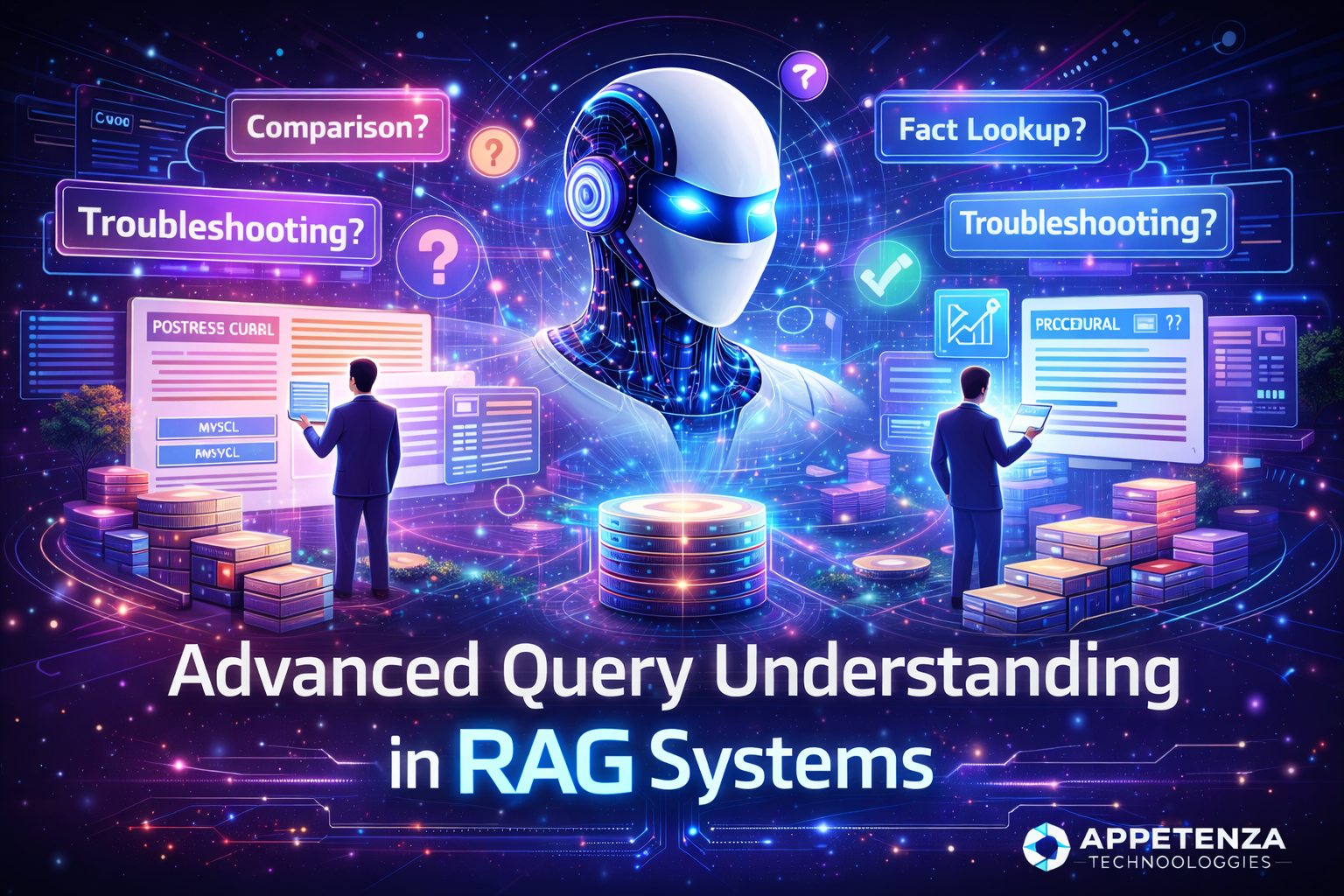
Advanced Query Understanding in RAG Systems: Interpreting User Intent Before Retrieval
-
 Appetenza
- 2 minutes, 48 seconds To Read
- 2026-01-31 23:37:36
One of the most overlooked components of a production Retrieval Augmented Generation (RAG) system is query understanding. Most beginner RAG pipelines immediately convert a user’s question into an embedding and search a vector database. While this works for simple fact-based queries, it often fails for complex, ambiguous, or multi-part questions. Advanced RAG systems introduce a query understanding layer before retrieval, allowing the system to classify intent, detect complexity, and choose the best retrieval strategy.
This extra intelligence layer is what separates a basic document search bot from a truly helpful AI assistant.
Why Basic Retrieval Fails for Complex Queries
Consider the question: “Which database is better for analytics, MySQL or PostgreSQL?”
A simple vector search may retrieve installation guides or general database descriptions. However, the user is asking for a comparison. Without understanding intent, the system may provide incomplete or irrelevant answers. Query understanding helps detect that this is a comparison query and retrieves benchmark or performance documents instead.
Types of Query Intent
- Fact Lookup – “What is Docker?”
- Troubleshooting – “Why is my server returning 502?”
- Comparison – “React vs Angular for enterprise apps”
- Procedural – “How to deploy FastAPI with Nginx?”
- Exploratory – “Best practices for cloud security”
- Summarization – “Summarize this policy document”
Each type benefits from different retrieval and prompting strategies.
How Systems Detect Intent
Intent detection can be implemented using lightweight classifiers or LLM-based preprocessing. A small model can label the query type before retrieval begins. This allows the system to adjust chunk selection, prompt structure, and answer formatting dynamically.
Multi-Step Queries
Some queries require multiple retrieval passes. Example: “Compare Redis and Memcached, and tell me when to use each.” This needs both comparison and recommendation logic. Advanced RAG systems may break such queries into sub-questions and retrieve context separately.
Handling Ambiguity
If a user asks, “How do I fix it?”, the system must rely on previous conversation memory or ask a clarifying question. Query understanding prevents meaningless retrieval attempts.
Benefits of Intent-Aware Retrieval
- Higher answer relevance
- Better context selection
- Reduced hallucinations
- Improved user satisfaction
Conclusion
Advanced query understanding transforms RAG from a static retrieval system into a dynamic, context-aware assistant. By detecting user intent early, systems deliver more accurate and meaningful answers.
